How Home Service Businesses Can Use Google Ads Without Wasting Their Marketing Budget
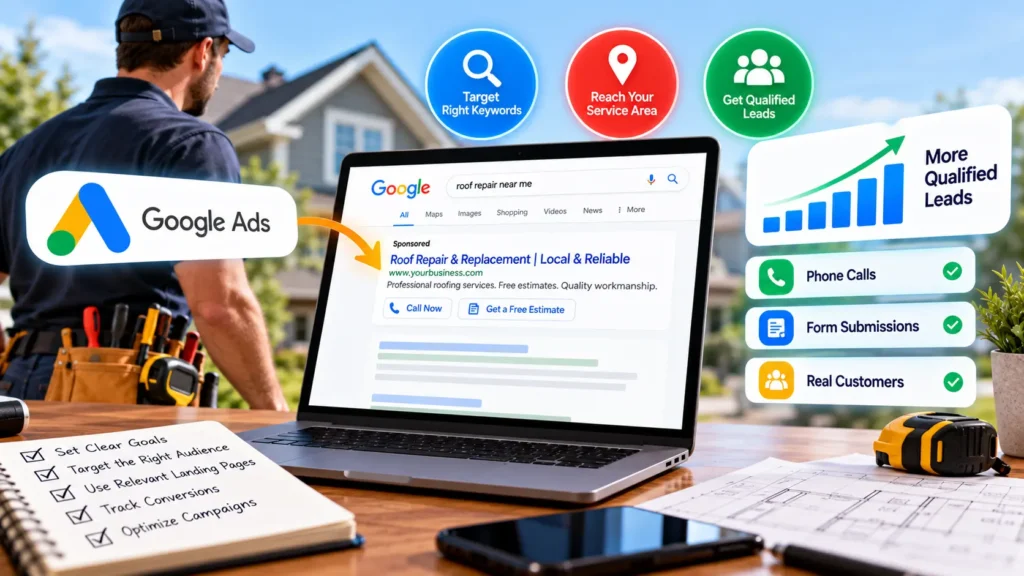
Google Ads can put a home service business in front of people who are actively looking for help, but that visibility comes with a cost. Every click uses part of the advertising budget, whether the visitor eventually becomes a customer or simply leaves the website.
For contractors and service businesses working with limited marketing budgets, the goal should not be to generate as many clicks as possible. It should be to attract relevant searches, send those visitors to useful pages, and measure whether the resulting inquiries are actually worth pursuing.
A carefully structured campaign can make that process much more manageable.
Start With the Services That Matter Most
One of the easiest ways to waste advertising money is trying to promote every service at once.
A contractor may offer roofing, siding, gutters, windows, repairs, maintenance, and several other services. That does not mean every service needs its own advertising budget immediately.
Start with services that have a clear commercial purpose and that the business is prepared to handle.
For example, a plumbing company might initially focus on emergency plumbing, drain cleaning, or water heater replacement rather than advertising every service listed on its website.
This approach makes the campaign easier to organize and gives the business a clearer understanding of which services are generating worthwhile inquiries.
It also makes the advertising message more specific. Someone searching for water heater replacement should see an ad and landing page that directly address water heater replacement rather than a generic message about plumbing.
Businesses that want to combine paid advertising with additional customer acquisition channels can also explore Home Pro Leads as part of a broader approach to generating opportunities.
Match Ads With Real Search Intent
Keywords matter, but the words someone types into Google are only part of the picture. The intent behind the search is equally important.
Consider the difference between searches such as “how to fix a leaking faucet” and “plumber near me.”
The first may come from someone looking for a DIY solution. The second suggests that the person may be looking for a professional.
That distinction matters when deciding where advertising money should go.
A home service business should consider whether a search suggests that someone is researching, comparing options, or actively looking to hire.
Google’s official Search campaign guidance explains that Search campaigns can target people actively searching for products or services and emphasizes keeping keywords, ads, and landing pages relevant to one another.
For contractors, this means building campaigns around the searches that have a realistic connection to the services being sold rather than simply choosing keywords with high search volume.
Use Negative Keywords to Reduce Irrelevant Clicks
Not every search containing a service-related word is valuable.
A company that sells professional roof replacement, for example, may not want to pay for clicks from people searching for roofing jobs, roofing courses, DIY instructions, or free materials.
Negative keywords can help prevent some of these searches from triggering ads.
The exact exclusions will depend on the business, but reviewing actual search queries regularly can reveal patterns that were not obvious during the initial campaign setup.
This is one of the reasons campaigns should not simply be launched and forgotten.
Search behavior provides ongoing information about what people are actually looking for, and that information can be used to refine targeting.
Control Geographic Targeting Carefully
Location is particularly important for home service businesses because contractors usually operate within a defined service area.
Advertising outside that area can produce clicks and inquiries that have little practical value.
A business should define where it can realistically send technicians or crews and structure campaigns around those areas.
It can also make sense to separate campaigns or ad groups when different areas have significantly different priorities.
For example, a contractor serving a large metropolitan area might organize campaigns around individual service regions if customer demand, travel considerations, or service availability vary substantially.
Geographic targeting should also be reviewed periodically. Service areas change, and advertising settings can sometimes reach people whose connection to a location is different from what the business expects.
Build Landing Pages Around the Customer’s Need
Sending every Google Ads visitor to the homepage is often a missed opportunity.
Someone searching for “emergency furnace repair” should ideally arrive on a page specifically about furnace repair rather than having to search through the entire website.
The landing page should continue the conversation started by the advertisement.
If the ad mentions emergency service, the page should explain that service. If the ad promotes a particular type of installation, the destination should provide relevant information about that installation.
The page should also make the next step straightforward.
Depending on the business, that might be a phone call, estimate request, consultation form, booking request, or another appropriate action.
Relevance helps visitors quickly determine whether they have found the right provider.
Track Calls and Form Submissions
Clicks are useful, but they are not the final goal for most home service businesses.
A contractor generally wants calls, quote requests, consultations, appointments, or booked work.
That makes conversion tracking essential.
A business should identify which actions count as meaningful conversions and make sure those actions are being measured properly.
For some companies, phone calls may be the most important conversion. For others, website forms or appointment bookings may matter more.
Tracking several actions can be useful, but businesses should distinguish between strong indicators of customer intent and weaker actions such as simply viewing a page.
The difference matters because a campaign can appear successful when it generates many low-value actions while producing relatively few genuine opportunities.
Pay Attention to Lead Quality, Not Just Cost Per Click
A low cost per click can look attractive, but inexpensive clicks are not necessarily valuable clicks.
Imagine two campaigns.
The first generates many inexpensive inquiries, but most people are outside the service area or looking for work the company does not provide.
The second costs more per click but produces fewer, highly relevant inquiries from customers who are actually looking for the advertised service.
The second campaign may be more useful to the business even though the initial advertising metrics appear less impressive.
This is why contractors should track what happens after the click.
Useful measurements can include qualified inquiries, estimates, appointments, booked jobs, and revenue where the business has the systems to measure them.
Set a Budget That Reflects Capacity
Advertising budgets should not be determined in isolation.
A business should consider how many additional jobs it can realistically handle.
If a contractor is already operating at capacity, aggressively increasing advertising spend may create more inquiries than the team can respond to.
On the other hand, a company with available crews and a clear need for additional work may have more reason to expand its campaigns gradually.
Starting with a defined daily or monthly budget also makes it easier to evaluate results without allowing spending to grow simply because the campaign is receiving clicks.
Budget increases should ideally follow evidence that the existing campaign is producing useful opportunities.
Review Campaigns Regularly
Google Ads campaigns need ongoing attention.
One week may reveal irrelevant search terms. Another may show that one service is attracting better inquiries than another. Seasonal demand can also change what customers search for.
Regular reviews can cover:
- Search terms generating clicks
- Keywords producing conversions
- Irrelevant searches to exclude
- Geographic performance
- Landing-page behavior
- Phone and form conversions
- Cost per qualified opportunity
The purpose is not to change everything every few days.
Frequent unnecessary changes can make it harder to understand what actually caused a performance shift. Instead, businesses should identify clear problems or opportunities and make controlled adjustments.
Consider More Than One Lead Source
Google Ads can be useful, but it does not need to carry the entire customer acquisition strategy.
A service business may also generate opportunities through organic search, referrals, social media, email, repeat customers, partnerships, directories, or external lead-generation services.
Different channels can serve different purposes.
A business might use Google Ads to capture immediate demand while building longer-term visibility through useful website content and customer referrals.
For contractors that want to supplement their own marketing efforts, lead generation support for home service businesses can be considered alongside internal advertising, provided the business has a clear process for qualifying and following up with incoming opportunities.
The important point is to evaluate each source based on the quality of the customers it produces rather than simply counting how many leads arrive.
Make Every Dollar Accountable to a Business Goal
Google Ads becomes easier to manage when the business knows what it is trying to accomplish.
A contractor might want more qualified estimates for a particular service. Another company may be trying to fill appointment slots during a slower period. A larger service business may be focused on acquiring customers in specific areas.
Those goals should influence campaign structure, targeting, landing pages, conversion tracking, and budget decisions.
The strongest campaigns are not necessarily the ones that generate the most clicks. They are the ones where the business can understand how advertising spend connects to meaningful customer activity.
For home service businesses, that means starting with specific services, targeting relevant searches, controlling geography, building useful landing pages, measuring real conversions, and continually learning from the inquiries that come through.
That process gives a contractor something more valuable than traffic alone: a clearer understanding of which advertising activity is actually contributing to the business.